What is the Trigone in the bladder
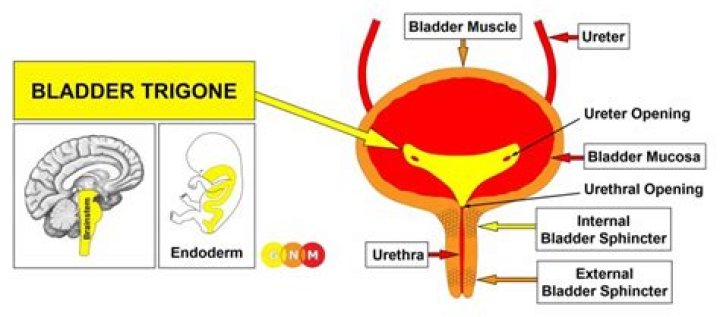
Trigone. The trigone is a triangular portion of the bladder floor bordered (ventrally) by the internal urethral opening or bladder neck and (dorsolaterally) by the orifices of the right ureter and left ureter.
Why is the trigone of bladder important?
Trigone. The trigone is a triangular muscular structure located between the bladder and urethra. Effective connection between the ureters and the trigone are vital for proper functioning of the ureteral valve mechanism.
Is trigone a muscle?
The upper and lower urinary tract compartments form independently, connecting at mid-gestation when the ureters move from their primary insertion site in the Wolffian ducts to the trigone, a muscular structure comprising the bladder floor just above the urethra.
Is trigonitis curable?
Following the treatment, 30% of patients considered themselves cured and 41% reported symptom improvement. On follow-up cystoscopy in 31 patients, trigonitis was completely resolved in 8 cases and improved in 12 cases.What contains the trigone?
The inner lining of the urinary bladder is a mucous membrane of transitional epithelium that is continuous with that in the ureters. When the bladder is empty, the mucosa has numerous folds called rugae. … There is a triangular area, called the trigone, formed by three openings in the floor of the urinary bladder.
Why is trigone medically important?
Trigone of urinary bladderFMA15910Anatomical terminology
What is Fulguration of the bladder?
A procedure that uses heat from an electric current to destroy abnormal tissue, such as a tumor or other lesion. It may also be used to control bleeding during surgery or after an injury.
How long does it take to do a cystoscopy?
A simple outpatient cystoscopy can take five to 15 minutes. When done in a hospital with sedation or general anesthesia, cystoscopy takes about 15 to 30 minutes. Your cystoscopy procedure might follow this process: You’ll be asked to empty your bladder.What are the signs of Trigonitis?
- an urgent need to urinate.
- pelvic pain or pressure.
- difficulty urinating.
- pain during urination.
- blood in the urine.
In a normal dog, urine is emptied from the bladder, leaving the body through a single tube called the urethra. The urethra starts at the bladder and provides the exit path out of the body.
Article first time published onWhat is a female dogs pee area called?
The urethra is the opening, or tube, in which urine is expelled from the body. The bladder sphincter muscle has the responsibility of keeping the dog’s bladder closed, and this is located at the top of the urethra.
What is the covering of the kidney called?
Each kidney is held in place by connective tissue, called renal fascia, and is surrounded by a thick layer of adipose tissue, called perirenal fat, which helps to protect it. A tough, fibrous, connective tissue renal capsule closely envelopes each kidney and provides support for the soft tissue that is inside.
What receives urine from the ureters?
The ureters are two tubes that drain urine from the kidneys to the bladder. Each ureter is a muscular tube that drains into the bladder. Smooth muscle contractions in the walls of the ureters, over time, send the urine in small spurts into the bladder, the organ where urine is stored before it can be eliminated.
Are you asleep during a cystoscopy?
You are awake during the procedure. Your doctor puts an anesthetic gel into your urethra. This numbs the area so you have no discomfort.
Why do they cauterize a bladder?
Cauterization involves the use of a small electric charge to stop bleeding. When cystoscopy has been completed, fluid is drained from the bladder.
Is fulguration of bladder painful?
Adding biopsy and fulguration caused a slightly higher grade of pain or discomfort, but was still tolerated well by most patients.
What is similar to interstitial cystitis?
The clinical presentation of interstitial cystitis is similar to that of many other conditions commonly seen in female patients, including recurrent urinary tract infections, endometriosis, chronic pelvic pain, vulvodynia, and overactive bladder.
What happens when you have cystitis?
The main symptoms of cystitis include: pain, burning or stinging when you pee. needing to pee more often and urgently than normal. urine that’s dark, cloudy or strong smelling.
How is chronic UTI treated?
A course of antibiotics delivered over one week is the primary treatment for UTIs. However, if you have chronic UTIs, your doctor may likely prescribe long-term, low-dose antibiotics for more than one week after the initial symptoms subside. In many cases, this helps prevent symptoms from recurring.
What is the STD that starts with at?
Trichomoniasis (or “trich”) is a very common sexually transmitted disease (STD). It is caused by infection with a protozoan parasite called Trichomonas vaginalis. Although symptoms of the disease vary, most people who have the parasite cannot tell they are infected.
What is pseudomembranous Trigonitis?
Pseudomembranous trigonitis is the term used to describe squamous metaplastic changes of the bladder trigone, which affect nearly 40% of adult females. We present the characteristics of this underrecognized clinical entity and encourage further relevant research.
What organs are close to bladder?
The bladder is connected to the kidneys by two long tubes called ureters. When urine is produced by the kidneys, it travels down the ureters to the bladder, where it is stored.
What type of sedation is used for cystoscopy?
For a rigid cystoscopy: you’re given an injection of general anaesthetic (which makes you fall asleep) into your hand, or a spinal anaesthetic (which numbs the lower half of your body) into your lower back.
Why would a urologist order a cystoscopy?
During a cystoscopy, a urinary tract specialist (urologist) uses a scope to view the inside of the bladder and urethra. Doctors use cystoscopy to diagnose and treat urinary tract problems. These problems include bladder cancer, bladder control issues, enlarged prostates and urinary tract infections.
Why did my cystoscopy hurt so bad?
Studies have demonstrated that the most painful part of flexible cystoscopy is when the tip of the cystoscope is inserted into the outer urinary opening.
Why do guys pee double stream?
It happens when the edges of the urethra get temporarily stuck together. The urethra is the tube that carries urine (and also semen, in men) out of the body. This sticky situation is often caused by dry ejaculate that doesn’t fully exit the urethra, gumming up the pipes.
Why is my dog's pee area red?
For many dogs, blood in the urine (hematuria) could be caused by a urinary tract infection, or in male dogs, a benign prostate problem. Typically when there is blood in your dog’s urine, this is due to inflammation or infection in the urinary tract which could include the upper or lower urinary tract.
Why is my dog's pee hole black?
Brown or Black: If you’re noticing a brown or black color to your dog’s urine it most likely means that there’s been some significant damage to their muscles (like from trauma, prolonged seizures, or even from a metaldehyde-based slug and snail bait poisoning).
How Long Can dogs hold their pee?
Adult dogs can hold their pee for up to 10-12 hours if needed, but that doesn’t mean that they should. The average adult dog should be allowed to relieve itself at least 3-5 times per day. That’s at least once every 8 hours.
Do male dogs have nipples?
Yes, both male and female dogs have nipples. These small bumps extend from their groin area up their stomachs, and the number of nipples can vary. Dogs tend to have between 8 and 10 nipples, but some have more, while others have fewer nipples.
What is medulla in kidney?
The renal medulla is the innermost part of the kidney. The renal medulla is split up into a number of sections, known as the renal pyramids. … The renal medulla (Latin: medulla renis ‘marrow of the kidney’) contains the structures of the nephrons responsible for maintaining the salt and water balance of the blood.
